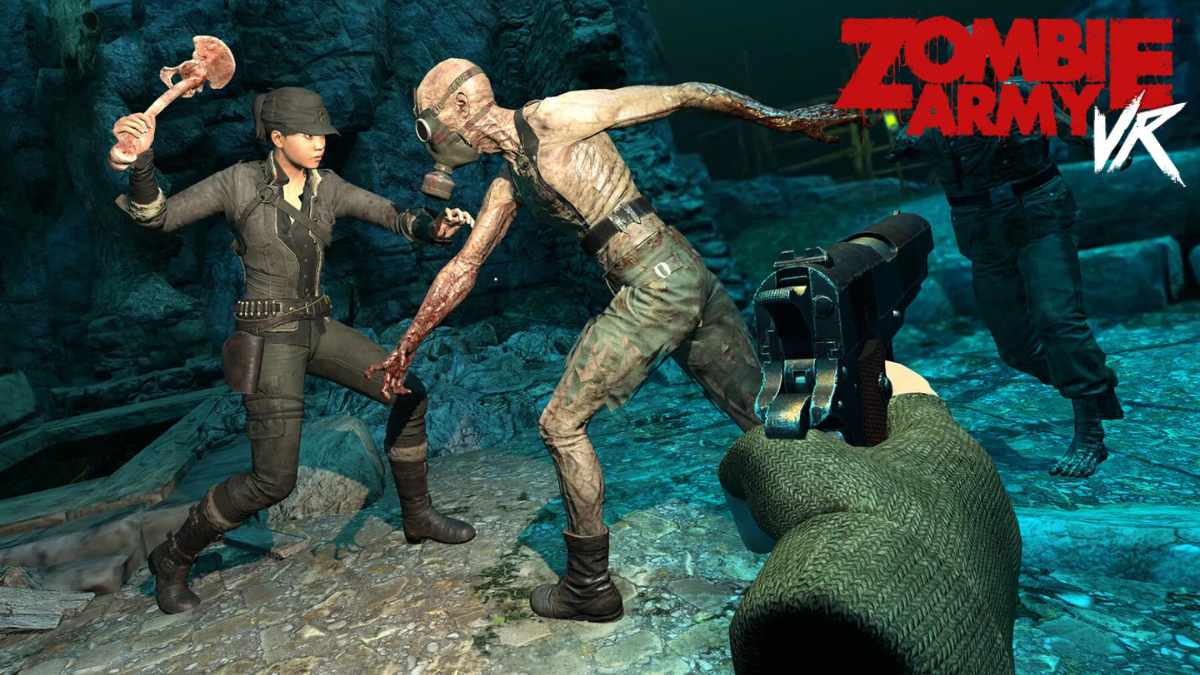
Zombie Army VR shifts gears from the series’ usual long-distance shooting and drops players into something closer to a shooting gallery—one packed with undead soldiers, twitchy headshots, and fast reloads. It doesn’t aim for deep systems or long-form storytelling. Instead, it leans into immediacy. It wants you shooting quickly, moving constantly, and repeating it across mission chunks.
It’s less of a slow-burn war game and more of a brisk, blood-soaked VR experience. Whether that works depends on what you’re looking for in a zombie shooter, but it knows exactly the kind of pace it’s going for.
Gameplay trades sniping for fast-paced shootouts
The original Zombie Army games spun out of Sniper Elite, which meant lots of long-range killcams and scoped precision. That’s mostly gone here. In VR, you’re rarely more than a few meters from the action. The focus is on room-scale play with rapid weapon handling and short burst encounters.
Enemy waves come fast, and you’re expected to juggle shotguns, rifles, grenades, and melee hits with barely a breather in between. Reloading is manual, movement is mostly stick-based with light room interaction, and the progression is mission-based. It’s not full open-world or sandbox, but each level gives enough space for tactical repositioning and flanking.
Visuals feel clean, if a bit plain
On Quest 3, visuals are crisp but not particularly striking. The undead designs follow a familiar formula—Nazi zombie tropes with glowing eyes and chunky limbs. Maps are mostly corridors, bunkers, and war-torn streets. It’s functional and readable, but rarely surprising.
PSVR 2 and PC VR versions see slight boosts in texture quality and lighting, but the art style stays grounded in utility. The real focus is clarity. You always know where enemies are coming from, which tools are in reach, and where you can move. It’s a practical design choice that prioritizes performance and immersion over high-end detail.
Weapon handling is tight and satisfying
The core loop of grabbing, aiming, reloading, and shooting feels good. Each weapon has its own weight and rhythm, and the game rewards accuracy with punchy feedback. Explosive traps and environmental kills add some flair, though it’s mostly about keeping your hands busy and your shots clean.
There’s some basic upgrade progression—mainly through unlocks tied to mission completion—but no complex skill trees or loadout tinkering. The simplicity works in its favor. You’re not in menus long, and you’re never too far from your next fight.
Campaign structure and pacing
The campaign is broken into short missions that often feel like mini-challenges rather than full story arcs. Some involve holding out in a position, others focus on clearing corridors or rescuing NPCs. Cutscenes are sparse and mostly static, serving as brief context rather than narrative drivers.
It’s clearly built for session play. You can jump in, run a mission, and bounce without worrying about losing track of deeper mechanics. That might disappoint players expecting a tighter narrative thread, but the tradeoff is a smoother gameplay loop.
VR-first design helps it stand apart
Zombie Army VR doesn’t feel like a flat game ported into virtual reality. The level layout, movement flow, and interaction systems are clearly designed with VR in mind. Cover is at physical height. Enemies rush from blind spots. Reload timing actually matters. Those details make the experience feel more grounded, even if the broader design sticks to arcade rhythms.
Compared to other VR zombie shooters like After the Fall or The Walking Dead: Saints & Sinners, it falls closer to the former—faster, more repetitive, but more accessible. It’s not survival horror. It’s action-first.
Final thoughts
Zombie Army VR knows its identity. It’s not trying to be a horror sim or a sandbox stealth title. It’s a punchy, action-heavy shooter designed for fast sessions and instant engagement. That won’t be enough for everyone, but for players looking for clean VR combat with minimal downtime, it lands where it needs to.

Virtual Reality Explorer & Game Reviewer
Always the first to plug in. VRSCOUT dives head-first into the most immersive VR worlds, analyzing mechanics, comfort, innovation, and that elusive “presence” factor. If he says it’s worth it, it probably is.